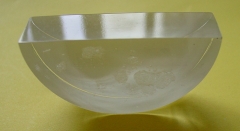
Spherical plano-convex lens with the curved surface
facing upward.
Concex 2
Spherical plano-convex lens with the curved surface
facing downward.
Concex 3
Cylindrical plano-convex lens with the curved surface
facing upward.
Concex 4
Cylindrical plano-convex lens with the curved surface
facing downward.
Concave 1
Spherical plano-concave lens with the curved surface
facing upward.
Concave 2
Spherical plano-concave lens with the curved surface
facing downward.
Concave 3
Cylindrical plano-concave lens with the curved surface
facing upward.
Concave 4
Cylindrical plano-concave lens with the curved surface
facing downward.
Prismatic 1
45-90-45 prism with the hypotenuse facing upward
and the right angle placing at the right
Prismatic 2
45-90-45 prism with the hypotenuse facing downward
and right angle placing at the left
2.
The lengths h and R in the ratio h/R are
3.
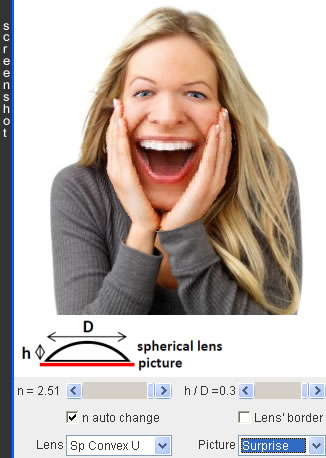
The image is calculated on the assumption that the observer
is far away from the lens and the picture being observed is put under
and close to the lens.
4.
This applet is written in full accord with Snell's law
of refraction. The images seen through the virtual lenses are perfectly
identical to the real ones. Click
here to see a comparsion of them.
5.
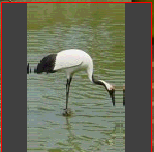
If either the ratio h/R or the index of refraction (n) is too large,
opague region(s) may appear at the edge of the lens.
Indeed, this phenomenon is very common.
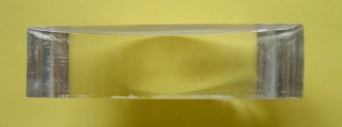
Stand a transparent semi-circular block upright
with its flat surface facing upward. When viewed from the top,
the two ends of the upper flat surface do not show any images
of the bottom paper.
Practically, this can serve as an easy method of finding the
index of refraction of the block.